Yes, if your crew handles paints, coatings or pesticides, OSHA 1926.51(f)(1) requires washing facilities on site. General jobsite sanitation falls under OSHA 1926.51(c), which sets toilet ratios but does not by itself mandate handwashing. Most Kirkland job sites still add a station because clients and inspectors expect one.
OSHA 1926.51(f)(1) applies specifically to work involving paints, coatings, herbicides or insecticides, or other tasks where harmful contaminants show up on skin. That is a narrow trigger, not a blanket rule for every construction site in Kirkland. Separately, OSHA 1926.51(c) sets the toilet count you need per crew size, and once you have portable toilet rental on site, pairing it with a wash station is standard practice, not an add-on. If your project touches general industry rather than construction, the ratio comes from 29 CFR 1910.141(c)(1)(i) instead. Confusing the two citations is common, and it is worth checking which one applies before you order equipment. A handwashing station rental run alongside your toilets covers both the contaminant-specific rule and the general expectation crews and clients bring to a site. For agricultural operations with hand-labor employees, OSHA 1928.110 sets a different standard: one facility per 20 workers, reachable within a quarter mile walk, which matters for anyone running farm and agricultural restrooms here.
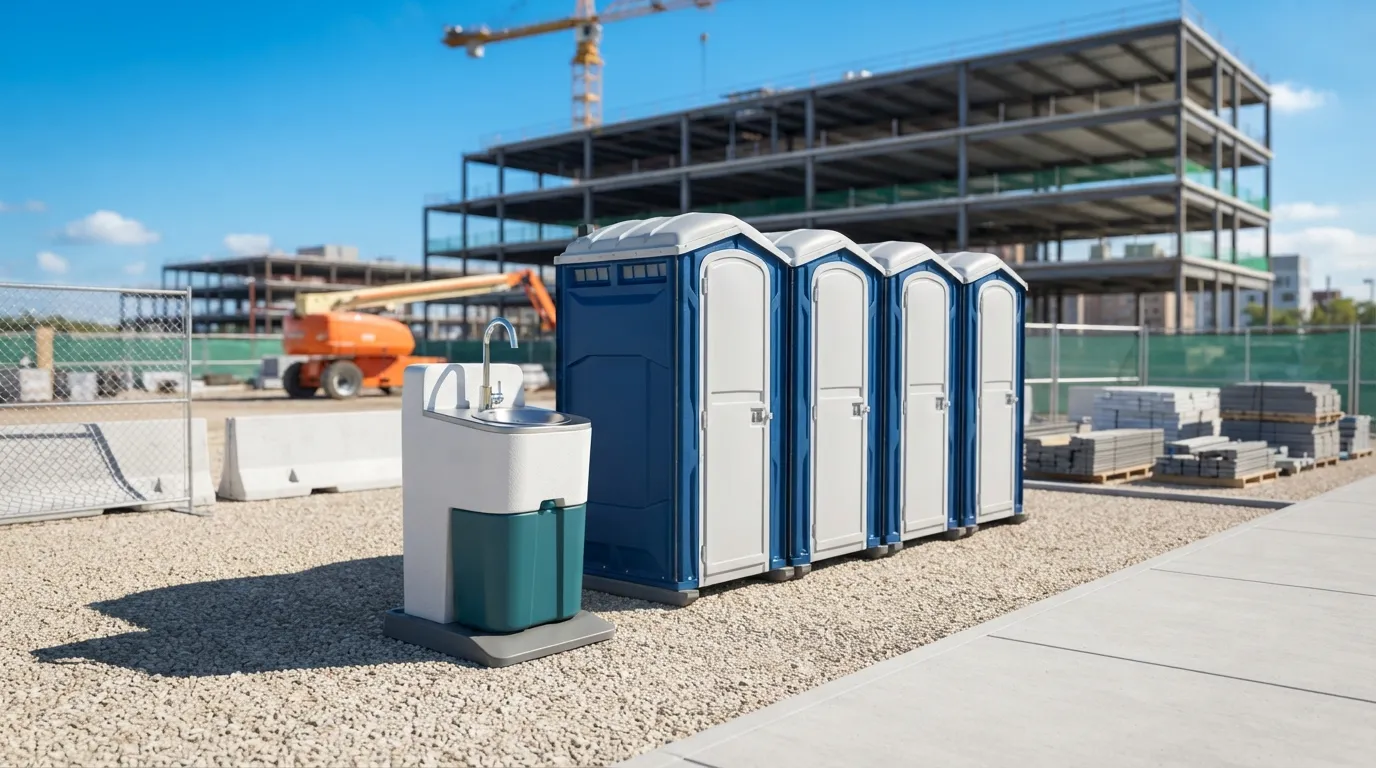
No. 29 CFR 1910.141(d)(2) is specific: washing facilities need soap and towels or a hand-drying device. Sanitizer alone does not satisfy that standard, even though it is faster to set up and cheaper to maintain. A hand sanitizer station rental works fine as a supplement near an entrance or a food table, but it cannot replace a real wash station where the rule applies. Kirkland job sites that only put out sanitizer and skip water-based washing are leaving a gap an inspector will flag. OSHA 1926.51(a)(1) also requires an adequate supply of potable water at every place of employment, which is the water source your wash station draws from. If you are unsure which setup satisfies your specific job, a portable sink rental with a built-in water tank is the straightforward fix, and it pairs naturally with a deluxe flushable porta potty if your crew wants something closer to a real restroom.
There is no fixed station-per-worker count in the OSHA language itself, but the toilet ratios in 1926.51(c) give a useful baseline: one toilet facility for 20 workers or fewer, then one seat and one urinal per 40 workers as crews scale past that, and one per 50 once you hit 200 workers or more. Most contractors in Kirkland match handwashing stations to that same headcount, placing one wash unit near each cluster of toilets rather than scattering them randomly across the site. ANSI/PSAI Z4.3 sets a baseline service interval of once per week for up to 10 users over a 40 hour week, which is a reasonable starting point for scheduling refills and pickups. If your project also needs ADA access, ADA Standards section 213.2 requires that at least 5 percent of clustered single-user units be accessible, with a minimum of one no matter how small the cluster is. That is worth planning for at the same time you order an ADA accessible porta potty, since retrofitting after delivery costs more time than it saves.
Right next to the toilets, and close enough to food or break areas that people actually use them. ADA Standards section 405.2 caps ramp slope at 1:12 if a station sits above grade, and section 302.1 requires the ground underneath to be stable, firm and slip resistant, which matters on a Kirkland site with gravel or mud underfoot. Section 308.2.1 sets forward reach limits of 48 inches high and 15 inches low for anyone using the unit from a seated position, and section 309.4 requires that faucets and controls work with one hand and no more than 5 pounds of force. None of that is exotic engineering. It just means placement and unit choice matter more than people assume. A porta potty placement guide walks through clearance and access details that apply just as well to wash stations. If your job runs through a Kirkland winter, check the notes on porta potty in winter before you finalize placement, since freezing lines change where a station can realistically sit.
| unit | duration | typical |
|---|---|---|
| standard porta potty | day | 150 |
| standard porta potty | week | 200 |
| standard porta potty | month | 200 |
| ada unit | week | 185 |
| delivery fee | week | 100 |
Full detail lives on the porta potty rental cost and monthly porta potty rental pages if you are budgeting a longer job.
Usually yes, if any painting, staining or pesticide work is involved, since that triggers OSHA 1926.51(f)(1) regardless of crew size. A home renovation porta potty order paired with a portable sink covers most homeowner projects in Kirkland without overbuilding the setup.
Yes, within reason. Placing one station per toilet cluster, rather than one per unit, is standard and keeps servicing simpler. Check how many porta potties do I need for headcount math before you order.
A handwashing station is typically foot-pump operated with a fresh and greywater tank; a portable sink adds a counter and sometimes hot water. Both satisfy 29 CFR 1910.141(d)(2) if stocked with soap and towels. See portable sink rental for specs.
Yes, food vendors and public gatherings typically expect them regardless of OSHA's construction-specific triggers. Check event restroom rental and festival restroom rental for setups that bundle toilets and wash stations together.
ANSI/PSAI Z4.3 sets a baseline of once weekly for up to 10 users over a standard workweek, though busier sites need more frequent visits. See how often are porta potties cleaned for service scheduling details specific to Kirkland crews.
Yes. Kirkland Porta Pros delivers handwashing station requirements across Kirkland and the surrounding metro, with same-day and next-day drop-off available on most orders.
Pricing depends on the unit and how long you need it. See our cost breakdown and request a free quote for an exact figure.
Standard rentals include scheduled service — a pump-out, a clean, a restock and fresh deodorizer. Busy or hot-weather sites can be serviced more often.
Call now or request a free quote — clean units, on-time delivery, transparent pricing.